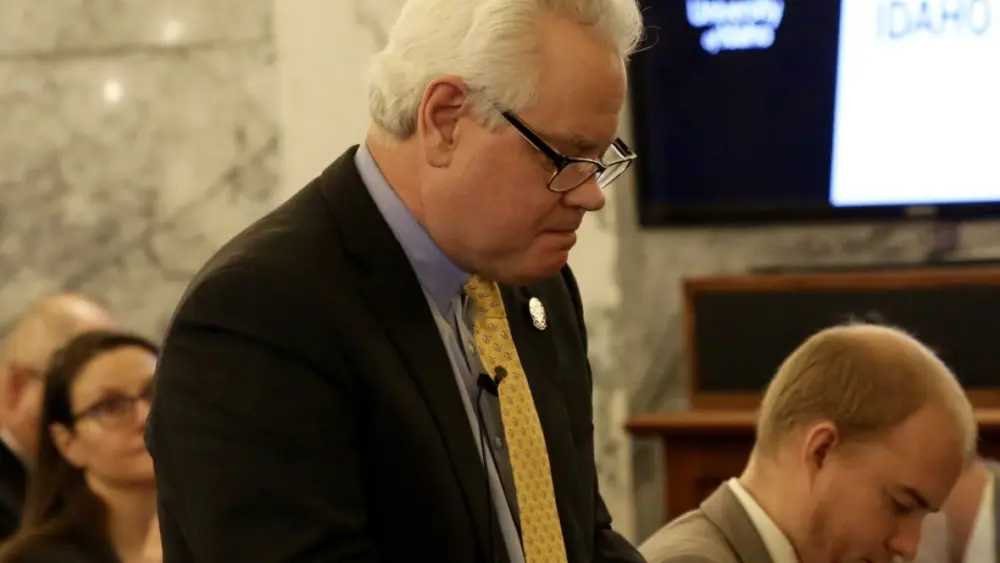
BOISE – University of Idaho President C. Scott Green made an emotional funding appeal Friday.
Fighting back tears. Green urged legislative budget-writers to fund Gov. Brad Little’s $1 million request, designed to cover costs stemming from the Nov. 13 slayings of four U of I students. The money would cover increased Idaho State Police patrols, enhanced campus security and counseling services, among other costs.
“I apologize for my moment,” said Green, after highlighting Little’s security request.
While most of Green’s budget presentation focused on nuts-and-bolts funding issues — from capital projects to the pressures of inflation — the events of Nov. 13 cast a shadow over Friday’s hearing. In addition to wearing his customary yellow necktie, Green also wore a wristband honoring by name the four victims: Ethan Chapin, 20, a freshman from Mount Vernon, Wash.; Kaylee Goncalves, 21, a senior from Rathdrum; Xana Kernodle, 20, a junior from Post Falls; and Madison Mogen, 21, a senior from Coeur d’Alene.
Several JFAC members took a moment to extend their condolences, and commend Green for his leadership in the aftermath of the slayings.
The $1 million is technically a “supplemental” request, which means it’s designed to cover costs already incurred during the current budget year, which ends June 30. Classes at the U of I resumed on Jan. 11, with added ISP and campus security officers in place.
“We spent well in excess of $1 million on security,” Green told Idaho Education News after Friday’s hearing.
Scott Green answers questions about U of I security, inflation and DEI. Click here for the raw audio.
Green threw his support behind Little’s higher ed budget — which would provide the U of I with $190.4 million from state tax dollars and dedicated funds, such as tuition and fees. Little also has proposed funding several university building projects, on and off the university’s Moscow campus.
However, Green said the budget creates a hole, for the U of I and other colleges and universities. Little proposes a 4% pay raise for all state employees, but the budget doesn’t fully fund the higher ed raises. That would leave the colleges and universities to pick up the balance through tuition and fees.
Between unfunded CEC costs and inflation, the U of I is facing about a $1 million budget gap, Green said.
Like Boise State University President Marlene Tromp, who made her JFAC budget presentation Tuesday, Green faced questions over diversity, equity and inclusion programs.
Sen. Scott Herndon, R-Sagle, pegged the cost of the university’s DEI positions at about $1.5 million — and a bigger share of its overall budget, compared to Idaho State University and Lewis-Clark State College.
Green pushed back. He said 21 of the U of I’s 23 DEI-related positions are fully funded by outside sources, such as corporate, private and student funding. For the remaining two positions, the employees’ DEI-related work is funded through outside dollars, while state funding covers the balance of their salaries.
And Green also cited a recent review from Hawley Troxell, a Boise law firm, that found that the scope of the university’s DEI initiatives were in line with other Idaho institutions.
The latest Hawley Troxell report, obtained by Idaho EdNews this week, again found that the university’s diversity and inclusion efforts “do not rise to any level of impropriety.” The firm issued a similar report a year ago, reaching the same conclusion.
Green’s budget presentation coincided with some enrollment news from the U of I. Spring enrollment totaled 9,375, a 2.1% increase from a year ago. This means the university held its enrollment gains from the fall — even after an undetermined number of students left campus and studied from home after the quadruple homicide.
“Our students came back,” Green said Friday.
Green’s presentation closed out “Education Week” in JFAC — a series of higher ed and K-12 budget pitches. In several weeks, JFAC members will write a series of education budgets, which then have to pass both houses before they can go to Little’s desk.